
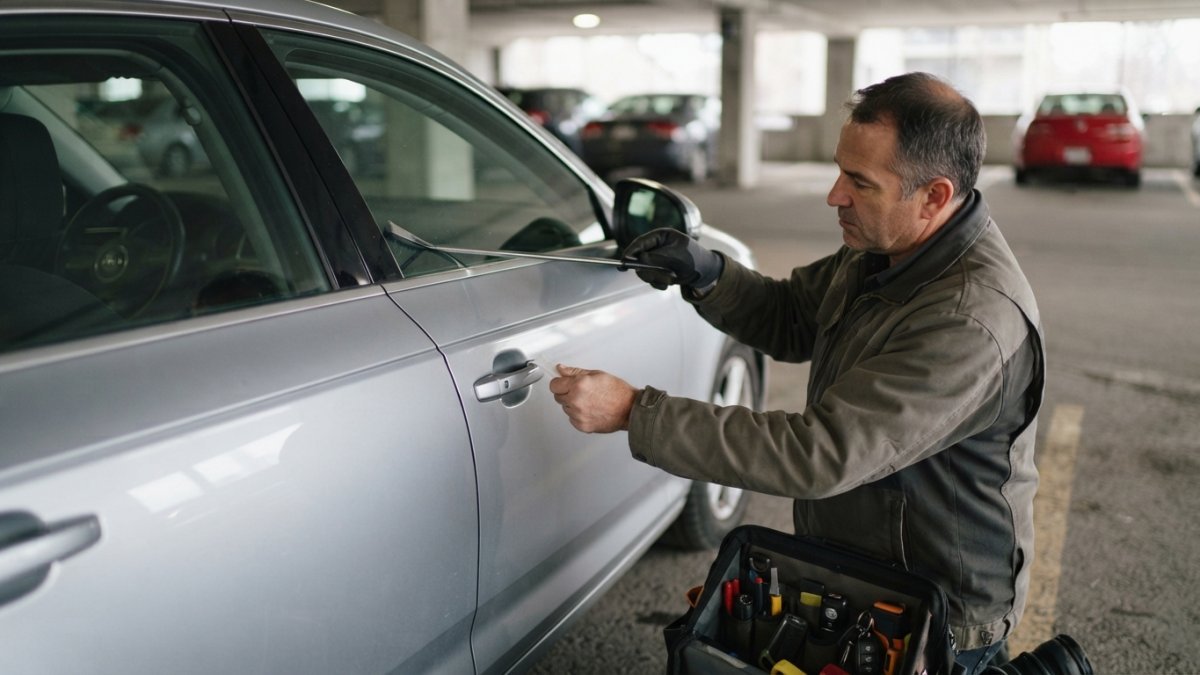
Table of Contents
- Start Here: A Safety-First Decision Tree for Any Lockout
- Keys Locked in Car: Your First 10 Minutes
- How to Unlock a Car Door Without a Key: DIY Methods Ranked by Risk
- How to Unlock Car Without Damage: What Actually Protects Your Paint and Seals
- Modern Vehicle Technology: Why Newer Cars Resist DIY Entry
- When to Call a Car Lockout Service (and What to Ask First)
- Legality, Proof of Ownership, and Letting a Stranger Into Your Car
- Prevention: How to Avoid the Next Lockout
- Frequently Asked Questions
Last Updated: October 19, 2026
Start Here: A Safety-First Decision Tree for Any Lockout
A locked car door is a stress test, not a puzzle to win. The safest path depends on three questions, answered in order.
Get the order right and you avoid the two things that actually cost money: bent door frames and broken glass.
Is Anyone Locked Inside?
Yes: call emergency services immediately. A child, a vulnerable adult, or a pet trapped in a vehicle is a medical emergency, not a locksmith job. Heat builds inside a closed cabin fast (Dangers of hot vehicles and children). Break the window on the side farthest from the person if responders instruct it, and never wait to “see if they’re okay.”
No: move to the next question.
Do You Have a Spare Key or Remote Unlock?
A spare key or a connected app is always the lowest-risk option. Check for a second fob, a hide-a-key, or a family member with a duplicate. If your vehicle has a connected services app, try the remote unlock button first. It costs nothing and damages nothing.
Can You Reach a Professional Quickly?
If a mobile locksmith can arrive within a reasonable window, wait. Professional entry uses proper tools and carries insurance. DIY entry is for the narrow case where help is hours away and no one is in danger.
The decision tree is the whole article in miniature: people first, keys second, professionals third, tools last. Most lockout damage happens when drivers skip straight to step four.
Keys Locked in Car: Your First 10 Minutes
First, stop pulling on the door handle. Modern locks do not respond to force, and yanking can damage the latch.
Then work through this checklist:
- Check every door, including the trunk and rear hatch. One is often left unlocked without the owner realizing.
- Look for a spare fob in a bag, jacket, or with whoever you were last with.
- Try the connected app if your vehicle has one.
- Note your exact location so you can give a clear address to a dispatcher.
- Move to safety if you are on a shoulder or in traffic. Stand behind a barrier, not beside the car.
- Call for help if steps 1 to 3 fail.
Have your proof of ownership ready before anyone arrives. It speeds up the whole process.
How to Unlock a Car Door Without a Key: DIY Methods Ranked by Risk
Some methods work. All carry risk, and the risk climbs sharply on newer vehicles. The ranking below runs from least to most dangerous for your car, with each entry covering the mechanism, the vehicles it fits, and the damage it can cause.
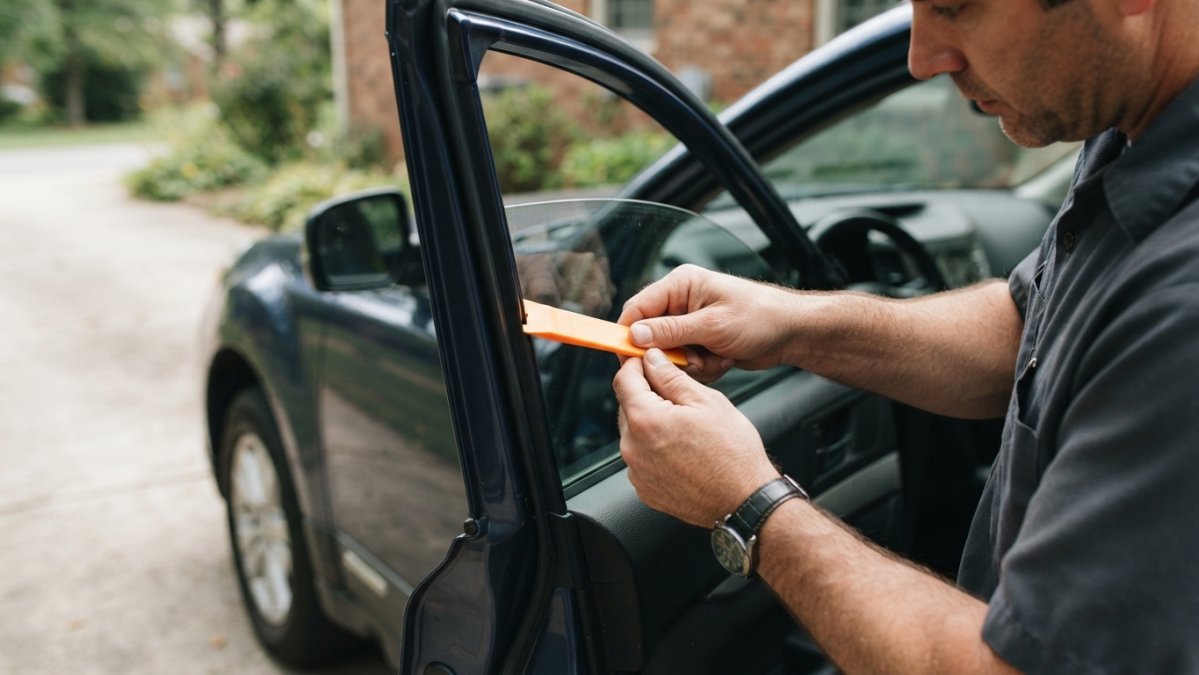
Shoelace or String Method (Older Manual Locks Only)
This is the classic trick, and it only works on older cars with a visible vertical lock knob that pulls straight up.
Tie a small loop in the middle of a long shoelace. Work the loop down through the window gap until it catches the lock knob.
Why it usually fails now: most vehicles built in the last two decades have no visible knob, and many have one flush with the door panel or integrated into the interior handle.
Wedge and Long-Reach Tool
A wedge opens a small gap at the top of the door frame. A long-reach tool then presses the unlock button or pulls the interior handle.
This works on more vehicles than the shoelace trick, but it is where most damage happens.
If you try it: use a proper plastic wedge, never a screwdriver, and apply gentle pressure only. Stop the moment you feel resistance.
Coat Hanger or Slim Tool
A straightened coat hanger can reach through the window gap to the interior handle or lock button.
The problem is control. Wire scratches paint and trim and can snag wiring inside the door. On vehicles with side airbags or door sensors, a stray hook is a genuinely bad idea: the harness that triggers the airbag runs through the same cavity a hanger passes through, and a snagged wire can disable the airbag or trigger a fault code that needs a dealer scan to clear.
Never use a slim jim or any tool on a door with side airbags or a modern sensor package. You can trigger the airbag or damage the wiring harness, and the repair bill will dwarf any locksmith call. The same caution applies to vehicles with laminated side glass, which chips and cracks instead of shattering cleanly.
What Changes by Vehicle Type
The method that fits depends less on the tool than on the lock design:
- Older vehicles with a visible lock knob: the shoelace method is the lowest-risk DIY option, and a wedge-and-reach tool is the fallback.
- Vehicles with a flush lock knob or electronic interior button: the shoelace method will not work, and a wedge-and-reach tool may work but carries seal and frame risk.
- Vehicles with keyless entry and a smart fob: there is often no mechanical linkage to reach at all, and the interior unlock button is electronic. DIY entry is not worth the risk.
If you are unsure which category your vehicle falls into, assume the most restrictive one. A professional locksmith can confirm the lock design before touching the car.
How to Unlock Car Without Damage: What Actually Protects Your Paint and Seals
The single biggest protection is knowing when to stop. Damage almost always comes from impatience, not the method.
What protects your vehicle:
- Plastic tools only. Metal on paint leaves marks that never buff out.
- Gentle pressure. If the gap will not open easily, the door is not the problem, the tool is.
- A second person to hold a light and watch the seal while you work.
What causes damage:
- Prying against the window glass instead of the frame
- Forcing a wedge too deep and bending the frame
- Snagging the weather seal and tearing it
A torn seal is the most common DIY casualty. It is also the one most owners do not notice until the first rain.
Modern Vehicle Technology: Why Newer Cars Resist DIY Entry
Newer vehicles are built to resist exactly these methods by design. Keyless entry, transponder keys, and smart fobs mean the lock is no longer a simple mechanical latch.
On many modern cars:
- There is no visible lock knob to catch
- The interior unlock button is electronic, not mechanical
- The door frame is tighter, with less flex before damage
A 2022 model with a smart fob is a different job from a 2004 sedan. If you drive a newer vehicle, DIY entry is not worth the risk; a professional with the right tools and on-site programming equipment can assist.
If your fob is dead rather than lost, check for a hidden mechanical key inside the fob shell. Many smart keys have one, and it opens the driver’s door through a covered keyhole.
When to Call a Car Lockout Service (and What to Ask First)
Call a car lockout service when no one is trapped, no spare key exists, and DIY entry would risk damage. For newer vehicles, that point arrives almost immediately. The harder question is which service to call, and what a fair quote looks like.
The Four Service Options, Compared
Most lockouts are solved by one of four routes. Each has a different trade-off between speed, cost, and risk.
- Roadside assistance (auto-club or insurer add-on): usually the lowest out-of-pocket cost if you already hold a membership or policy, but response times vary widely by location and time of day, and the dispatcher may route you to a contracted provider. Confirm whether lockout service is included or billed as a separate call.
- Mobile locksmith: the most direct route for a vehicle-specific job. A good locksmith carries the tools for your lock design and can often program a replacement key on site if the original is lost rather than locked inside. Pricing depends on the specific service required; ask for a quote before dispatch.
- Dealership service: the right choice when the vehicle needs a factory key programmed or a security system reset, but dealerships typically work by appointment during business hours and may require the vehicle to be towed in. Not a fast lockout option.
What a Fair Quote Includes
Ask these questions before you commit, and write down the answers:
- Are you available now, and what is your realistic arrival time? Get a number, not a range.
- What is the total price, including any call-out fee? Ask for it before dispatch, and ask whether tax is included.
- What happens if you cannot open the car? Confirm the policy up front, a fair provider does not charge full price for a failed attempt.
- Can you program a replacement key on site if the original is lost, not locked inside? Not every mobile provider carries programming equipment for every make.
- How do you verify ownership before touching the vehicle?
A quote that changes on arrival, a provider who cannot explain the process, or one who refuses to give a total before dispatch are all reasons to call someone else.
Response Time and Cost: What to Expect
Response time depends more on your location and the time of day than on the provider; a dense urban area during business hours usually sees a mobile locksmith faster than a highway shoulder at night.
Cost has several components, including a call-out or dispatch fee, labor for the entry, and any key programming if a replacement is needed. Ask for each separately to compare quotes fairly.
If you hold a roadside assistance membership, call it first and ask whether lockout service is covered at your location. If it is, the out-of-pocket cost may be lower than a direct locksmith call, even if the wait is longer. If no one is in danger and you can afford the wait, that trade-off is often worth taking.
When to Skip the Service Call
Do not call a locksmith if anyone is trapped inside, call emergency services first. Do not call one if you have a working spare key or a connected app that will unlock the car. And do not call one to force a door where the lock design makes DIY entry safe and you are confident in the method; save the call-out fee for cases that need it.
Legality, Proof of Ownership, and Letting a Stranger Into Your Car
Any legitimate provider will ask for proof of ownership before opening your vehicle. That protects you as much as them.
Have one of these ready:
- Vehicle registration
- Insurance documents
- A photo of your licence matching the registered owner
A professional who does not ask is a red flag. So is anyone who quotes a price and then raises it on arrival, or who cannot explain their process.
Never let someone open your car without verifying ownership, and never leave the scene while a stranger works on your vehicle. If a provider refuses to show identification or explain the process, call someone else.
Prevention: How to Avoid the Next Lockout
The cheapest lockout is the one you never have. A few habits cover most cases:
- Keep a spare fob stored away from the vehicle, not inside it.
- Set up your connected app before you need it.
- Check for the hidden mechanical key in your fob and know where it goes.
One more: if you lose a key rather than lock it inside, get it replaced promptly. A lost fob is a security issue, not just an inconvenience.
Frequently Asked Questions
How do you unlock your car if your keys are locked inside?
Work through the lowest-risk options first. Check whether a spare key exists at home or with a family member, and try a remote unlock app if your vehicle has one. If neither works, call a car lockout service rather than forcing the door. A professional technician uses proper tools to reach the lock mechanism through the window gap without bending the door frame or tearing the weather seal. Most lockouts are resolved on site, and you avoid the paint and seal damage that improvised tools often cause.
Can you unlock a car door without damaging it?
Yes, if you use the right method for your vehicle. A spare key, key fob remote unlock, or a mobile app causes zero damage. Professional technicians can also unlock car without damage by using a wedge and long-reach tool with controlled pressure. The risk rises sharply with improvised tools: coat hangers scratch paint, slim tools can bend lock rods, and forcing a wedge too far can distort the door frame or damage the window regulator. If you are unsure about your lock type, stop and call a professional.
What should you do if a child or pet is locked inside a car?
Treat it as an emergency. In Canada, call 911 immediately if a child or pet is locked inside, especially in warm or cold weather. Do not wait for a locksmith. While waiting, stay with the vehicle, keep the person or animal calm, and follow the dispatcher’s instructions. Emergency responders can break a window safely if needed. Never leave the scene to find tools. Once everyone is safe, a car lockout service can handle the lock and any key replacement afterward.
How long does a car lockout service take to arrive?
Response time depends on your location and the provider. A mobile service covering your area typically aims to arrive within about 30 minutes, but traffic and time of day affect that. When you call, ask for a realistic arrival window and confirm pricing before dispatch. Also ask whether the technician can program a replacement smart key on site, since modern vehicles often need transponder programming rather than a simple unlock.
A lockout is stressful, but it does not have to be expensive. The right order, people first and tools last, keeps your paint, seals, and wallet intact. When DIY is not worth the risk, Cle Auto Montreal provides 24/7 mobile unlocking, key replacement, and on-site smart key programming across Montreal, Laval, and the West Island, with nearly all makes and models covered and a 30-minute target response. Call 514-992-6628 and get back on the road.


